

Back in the day, most people pictured pharmacies as places with “white walls, harsh lights, long counters, and waiting in line for meds.” Sure, they got the job done efficiently, but they also made customers feel distant—like you’re just “checking off a task” instead of getting care and advice. Fast forward to 2026, pharmacies are evolving from simple “medication-dispensing spots” to front-door hubs for community health services. They’re now more like trusted, warm, multi-service, and efficient “wellness destinations.”
This “2026 Pharmacy Design” guide breaks down all the key ins and outs of modern pharmacy design—from interior style, layout, and customer flow to counters, privacy, lighting, materials, tech integration, sustainability, and compliance with standards like USP 797/800, HIPAA, and ADA. Whether you’re opening a new medical store, renovating a community pharmacy, or upgrading a small space for better efficiency, you can follow this framework to make it happen.
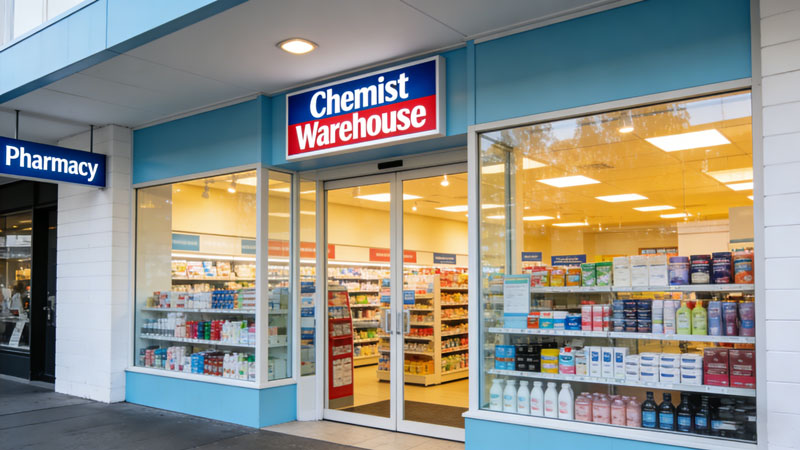
I. 2026 Pharmacy Design’s “New Positioning”: From Selling Meds to a Health Service Hub
1.Customer Expectations Have Changed: They Want to Stay Longer and Need Guidance
Pharmacies aren’t just for picking up prescriptions or OTC drugs anymore. Customers hope to get more “light medical services” in one place—health consultations, medication guidance, vaccine shots, basic screenings, telehealth support, and shopping for chronic disease management products. That shifts the design goals:
- Reduce anxiety: Move from “clinical and cold” to “professional yet warm”
- Boost browsability and clarity: Make it easier for customers to find products, understand info, and want to look around
- Build trust: Private consultations, cleanliness, clear flow, and efficient staff
- Monetize services: Blend health services with retail to increase average order value and repeat visits
2.Design Isn’t Just “Decoration”—It Drives Profit and Efficiency
A solid pharmacy design improves three things at once:
- Profitability: Better product visibility, longer customer stays, and more promotional touchpoints
- Workflow efficiency: Less walking, fewer mistakes, and faster medication dispensing/delivery
- Patient experience: Comfortable seating, clear signage, privacy protection, and manageable wait times
In a nutshell: Design isn’t a cost center—it’s part of your operational system.
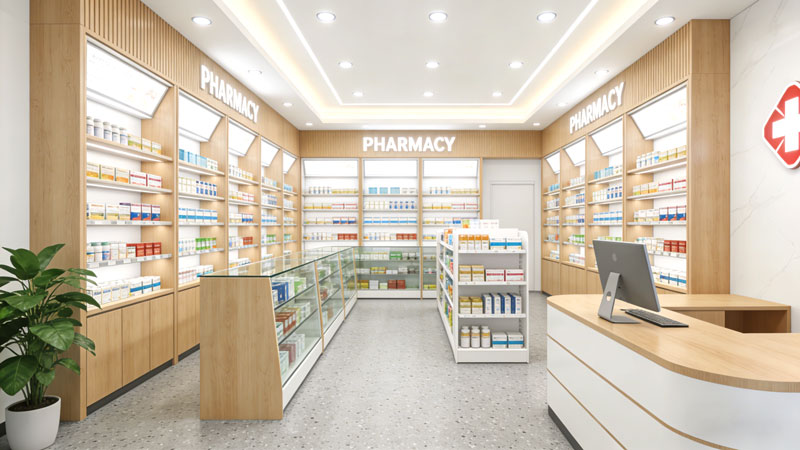
II. 2026 Pharmacy Interior Trends: From “Sterile” to “Healing”
- White signals cleanliness, hygiene, and medical credibility.
- Wood adds warmth, comfort, and a lifestyle vibe.
- Together, they hit that sweet spot of being “as professional as a medical facility” while feeling “as cozy as a wellness space.”
- Blue: Calming and trustworthy.
- Green: Healthy, energetic, and natural.
- Warm gray/beige: Softens the coldness and encourages customers to stay longer.
- Ambient light: Provides even brightness for safety and clarity.
- Task light: Brighter, more focused lighting at dispensing counters, consultation desks, and cash registers to boost accuracy.
- Accent light: Highlights end caps, themed displays, and health service areas to create “visual focal points.”
- Retail areas: Brighter and crisper (to make products stand out).
- Consultation/waiting areas: Warmer and softer (to reduce anxiety and enhance privacy).
- Countertops: Quartz or stain/scratch-resistant materials.
- Flooring: Easy to clean, slip-resistant, and durable (especially at entrances and high-traffic areas).
- High-touch surfaces: Antibacterial materials or easy-to-disinfect finishes.
- Soft furnishings: Washable, stain-resistant fabrics for seating.
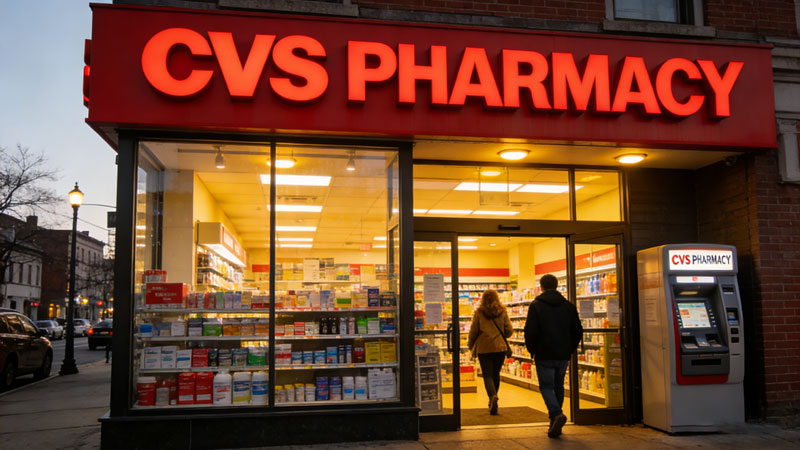
III. Layout & Customer Flow: A Good 2026 Design “Guides Customers Naturally”
The most important part of pharmacy design isn’t “how it looks”—it’s “how people move, stop, browse, ask questions, and pay.” These core flow principles still hold in 2026:
1.“Power Wall” on the Right Side of the Entrance: Grab Attention in 3 Seconds
Research and practice show most customers naturally turn right when entering a store and browse counterclockwise. Use the right side of the entrance as your “Power Wall” for:
- High-margin health products (vitamins, supplements, recovery gear like compression socks)
- Seasonal themes (flu season, allergy season, sunscreen season, back-to-school)
- New arrivals, bestsellers, and discount bundles
The goal of this wall: Make customers think “This pharmacy is worth checking out” within 3 seconds.
2.Add “Speed Bumps”: Make Customers Slow Down and Browse
“Speed bumps” are small, eye-catching displays that make customers pause—boosting add-on sales. Try:
- Island displays, end caps, or themed stacks
- High-contrast colors and accent lighting
- One clear “star product/service” per display (don’t try to push everything at once)
A common retail secret: Get customers to stay just a little longer, and sales will jump.
3.Prescription Counter & Pharmacy Workstation: Placement Matters for Sales
Here’s a no-nonsense rule from the experts: Put pharmacy workstations toward the back of the store. Customers picking up prescriptions usually have a clear goal—if the counter is too close to the entrance, they’ll grab their meds and leave without browsing the retail area.
In 2026, we recommend treating the counter as a “three-in-one system” with separate spaces:
- Drop-off area: For quick prescription submissions
- Pick-up area: To reduce crowding and optimize lines
- Consultation area: “Visible but private” so customers feel comfortable asking questions
4.Aisles & Accessibility: Width Isn’t Wasted—It’s an Experience and Safety Investment
Many pharmacy customers are seniors or have mobility issues, so design for “universal accessibility”:
- Wider main aisles to accommodate wheelchairs and walkers
- Lower service desks and partial low shelving for easy reach
- Large, high-contrast signage with braille/tactile guides if needed
- Slip-resistant flooring and uncluttered corners
This isn’t just about compliance (like ADA)—it directly impacts customer loyalty and repeat visits.
IV. Small-Space Pharmacies (2026): Compact but Fully Functional
Many community pharmacies have limited space but growing needs: consultations, vaccinations, screenings, retail, dispensing, and storage. The key for small stores isn’t “cramming more in”—it’s “modularity + verticality + multi-functionality.”
1. Vertical Storage: Maximize Walls, Keep High-Frequency Items Within Reach
- Floor-to-ceiling shelving for inventory and low-turnover products
- High-frequency items and core service points at eye/hand level
- Central retail shelving no taller than shoulder height to avoid blocking sightlines and feeling cramped
2.Multi-Functional Rooms: One Space = Consultation Room + Vaccination Room + Telehealth Booth
A small private room is incredibly valuable in 2026. It can be used for:
- Private medication consultations
- Vaccine administration/basic care
- Telehealth video calls
- Chronic disease management assessments
Key features: Soundproofing, easy cleaning, storage, and quick reconfiguration with modular furniture or movable screens.
3.Compact Dispensing Areas + Automation: Trade Tech for Space and Efficiency
Small stores hate when back-of-house spaces eat into customer areas. Fix this with:
- Streamlined workflows (reduce staff walking distance)
- Automated medication dispensing/storage systems (when budget allows)
RFID or smart shelving for real-time inventory tracking
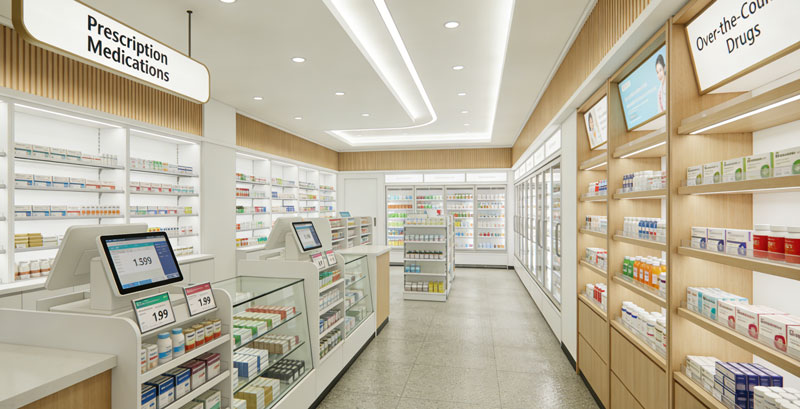
V. Modern Pharmacy Counter Design (2026): Balance Efficiency, Privacy, and Experience
The counter is the pharmacy’s “first point of contact.” It’s where transactions happen, trust is built, and privacy risks arise. A great 2026 counter design checks all three boxes:
1.Ergonomics & Work Efficiency
- Comfortable height for staff during long shifts
- Clear zoning for drop-off/pick-up/consultation to avoid interference
- Integrated equipment (prescription system screens, inventory tools, POS) with hidden cable management
- Key supplies within arm’s reach to reduce walking and mistakes
2.Privacy Protection: From “Shhh” to “Built-in Confidentiality”
Use a combination of:
- Modular privacy screens (movable and adjustable)
- Sound-absorbing materials on walls/ceilings in consultation areas to reduce noise
- Semi-private waiting areas (with plants, dividers, or seating layouts that prevent gawking)
- Private consultation rooms for sensitive conditions, chronic disease talks, or in-depth prescription guidance
3.Queue & Waiting Experience: Make Customers Feel “Cared For”
- Digital check-in/queuing systems
- Comfortable, easy-to-clean seating in waiting areas
- Health info screens, service introductions, or themed displays in waiting sightlines (keep info concise)
VI. Merchandising & Signage: 2026 “Browsability” Comes From Structure and Focus
1.Group by “Health Needs”—Not Just Brands
Friendlier grouping examples:
- Cold & fever / cough & sore throat
- Allergies / nasal congestion
- Digestive health
- Skin care
- Chronic disease support (blood pressure, blood sugar, cardiovascular)
- Home care & medical devices (band-aids, disinfectants, braces, monitors)
Benefit: Customers find solutions faster, and staff can easily make “solution-based recommendations.”
2.Create “Visual Focal Points”: One Star Per Display
How to do it:
- Each end cap/theme island features just one “star product/service”
- Highlight the star with lighting, elevation (risers/step displays), or contrasting colors
- Surround it with “complementary products” to create a complete solution
3. Signage: Your Store’s Self-Service Guide
2026 signage should:
- Be large, high-contrast, and readable from a distance
- Use consistent, clear category names
- Clearly direct to key areas (entrance, counter, consultation room, accessible routes)
Pair with digital signs for health education and service explanations
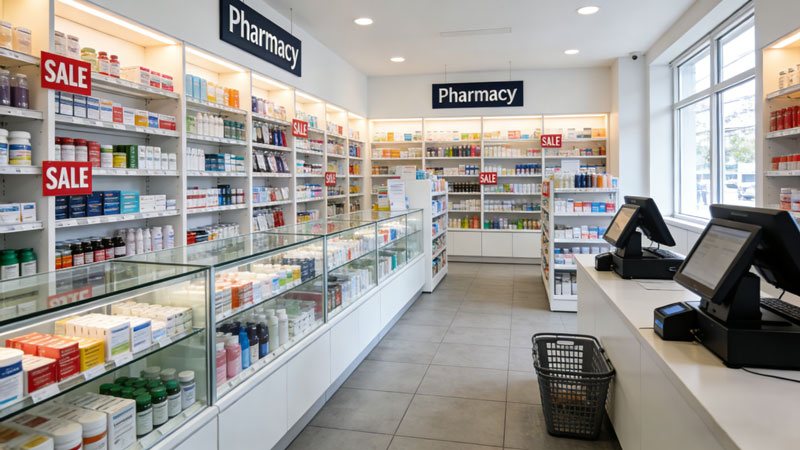
VII. Tech Integration: 2026 Pharmacy Design Must Reserve “System Space”
Gone are the days when “tech in pharmacies” meant “adding a computer.” In 2026, tech is “operational infrastructure embedded in the space.” Plan for it from the design stage:
1.Digital Signs & Interactive Kiosks: Info, Promotions, and Education in One
- Play health tips, seasonal reminders, and service offerings (vaccinations, screenings, consultations)
- Showcase events and promotions to cut down on paper materials
- Interactive kiosks for prescription refills, service bookings, and simple risk assessments
Placement tips: Waiting areas, queuing zones, and near entrances—avoid overcrowding with screens.
2.Automated Medication Dispensing & Storage: Efficiency and Accuracy Boosters
Why they’re worth it:
- Fewer human errors
- Faster dispensing
- More back-of-house space saved (especially for small stores)
- Integration with inventory systems to reduce stockouts and overstocking
3.Inventory Management: RFID, Smart Shelves, and Real-Time Replenishment
- RFID for real-time stock checks and automatic refill alerts
- Smart shelves that flag low stock for staff
- Especially effective for high-value and fast-moving products
4.Cybersecurity & Data Privacy: Require “Physical Space Support”
Equipment handling patient info needs:
- Secure placement and access controls
- Privacy screens
- Distance or dividers from customer areas
Pre-installed outlets, network ports, and cable management
VIII. Compliance & Safety: USP 797/800, Privacy, and Accessibility Are Non-Negotiable
Pharmacy design must “prioritize compliance before experience”—otherwise, renovation costs later will be sky-high.
1.USP 797: Cleanliness and Pressure Differential for Sterile Compounding
If offering sterile compounding:
- Cleanroom/laminar flow design
- Air filtration and pressure control
- Anteroom (buffer space) for handwashing, gowning, and prep
2.USP 800: Separate Handling for Hazardous Drugs
If handling hazardous drugs:
- Dedicated storage areas
- Proper ventilation and isolation
- Specialized compounding/handling spaces to avoid cross-contamination
3.Privacy Compliance (HIPAA-Aligned)
- Soundproofing and spatial separation in consultation areas
- Reduced proximity of onlookers at transaction points
- Waiting area layouts that minimize overhearing sensitive info
- Privacy screens for computers and clear boundaries for staff work areas
4.Accessibility (ADA-Aligned): Wide Aisles, Low Counters, and Clear Signage
- Aisle width and turning radius suitable for wheelchairs
- At least one low service point (e.g., a lowered section of the counter)
- High-contrast signage with braille/tactile cues if needed
Slip-resistant flooring and good lighting to reduce fall risks
IX. Sustainability & Long-Term ROI: 2026 “Savings” Come From Systematic Energy Efficiency and Durability
Pharmacies are long-term businesses—design for the big picture: maintenance costs, energy use, and update expenses.
1.Energy-Efficient Lighting & Systems
- LED lights + motion/zone controls to cut energy use
- High-efficiency HVAC + programmable thermostatsThese investments pay off steadily over time.
2.Low-VOC and Eco-Friendly Materials: Improve Air Quality and Brand Image
- Low-VOC paints and adhesives to reduce odors and irritation
- Renewable/recyclable materials add value for both the environment and brand storytelling
3. Reduce Waste: Start with “Going Paperless”
- Electronic prescriptions and digital queuing to cut paper use
- Digital signs replace posters and promotional flyers
Clear recycling stations to build sustainable operational habits
X. Turn Pharmacies Into “Community Health Centers”: Reimagine Front-of-House Value
1. Front-of-House = Your “Billboard” and Brand Statement
- I’m professional (clean, organized, clear processes)
- I’m friendly (comfortable, warm, easy to navigate, staff ready to help)
- I solve problems (visible services, easy consultations, needs-based product grouping)
2. 2026 Front-of-House “Health Touchpoints” to Add or Enhance
- Health consultation areas + professional private consultation rooms: Design them to feel “as professional as a medical space” with soundproofing and comfort—so customers feel safe talking about sensitive issues (privacy and trust drive repeat visits).
- Telehealth spaces: The future is integrating telehealth into pharmacies. Add private video consultation rooms/booths for remote calls with doctors or pharmacists (especially valuable for community and rural stores).
- POCT (Point-of-Care Testing) areas: If offering rapid tests or basic screenings (a growing trend), reserve a dedicated space—no workflow disruption, easy to clean, and private.
- Health education & small event spaces: You don’t need much room—just a “convertible” area that works as extra product display or waiting space during regular hours, and a workshop area for health talks or popular science sessions.
- 24/7 pickup lockers: Case studies show 24/7 pickup systems drastically improve the customer experience, reduce peak-hour crowding, and boost medication adherence (especially for chronic disease patients).
XI. Budget & ROI: 2026 Pharmacy Design Needs “Lifecycle Costing”
Pharmacy design is a big investment—don’t just look at upfront renovation costs. Consider operational savings, efficiency gains, sales growth, and brand premium.
1.Phased Implementation: Start With “Highest ROI” Areas
If budget is tight, upgrade in stages:
- First: Key areas (dispensing counters, consultation/privacy systems) that directly impact efficiency and trust.
- Next: Retail flow and merchandising systems (to boost stay time and sales).
- Finally: Full style unification and exterior/signage upgrades (to amplify brand).
2. Tech ROI: Automation Is Expensive Upfront, But Saves Big Long-Term
Experts highlight “Technology ROI”: Automated systems cost more initially, but the returns include:
- Higher dispensing accuracy and fewer mistakes
- Less staff walking and repetitive work
- More prescriptions and services handled with the same team
- Real-time inventory management to cut stockouts and overstocking
Key: Reserve space, wiring, and maintenance access during design—retrofitting later is costlier and messier.
3. Energy Efficiency Payback: LED and HVAC Save Over Time
Experts emphasize “Energy Efficiency Payback”:
- LED + motion controls cut ongoing energy costs
- High-efficiency HVAC + programmable thermostats reduce long-term operational expensesThese investments get more valuable the longer your pharmacy is open—especially for 24/7 stores.
XII. Case Studies: Turn “Good Looks” Into “Replicable Success Models”
Here are three typical successful cases for common pharmacy types—extract the methods and reuse them:
Case 1: 500 sq ft Urban Small Pharmacy (Compact but Functional)
Winning strategies:
- Vertical storage: Maximize wall space
- Compact robotic dispensing systems: Save back-of-house space and boost efficiency
- Flexible consultation area: Converts to a vaccination room during flu season
Takeaway: For small stores, don’t “cut corners”—use “verticality + automation + multi-functionality” to structure efficiency.
Case 2: 2000 sq ft Hospital Outpatient Pharmacy (High-Traffic, Process-Driven)
Winning strategies:
- Drive-thru pickup window: Boost convenience
- Digital queuing system: Reduce crowding and anxiety
- Larger wellness product section: OTC sales increased by 30% (per case data)
Takeaway: For high-traffic stores, make “queue experience” and “retail visibility” core design metrics.
Case 3: Rural Community Health Center Pharmacy (Large Service Radius, Limited Medical Resources)
Winning strategies:
- Telehealth integration: Private video consultation rooms
- 24/7 pickup lockers: Improved convenience and medication adherence (25% increase per case data)
Takeaway: When pharmacies take on more community health roles, “space + tech” extends medical accessibility.
XIII. 2026 Future Trends: Design for “Flexibility, Scalability, and Upgradeability”
The future of pharmacy design boils down to three keywords: flexibility, service-oriented, and digital integration.
1. More Flexible Space Systems: Modularity and Reconfigurability
- Modular shelving and displays: Easy to switch for seasons, themes, or product mix changes
- Convertible spaces: Consultation/event/vaccination areas that adapt to demand (e.g., flu season, promotions)
2. More Health Services in Pharmacies
- Telehealth integration
- Expanded POCT and health screening areas
- Focus on prevention and health management—not just “treating illness”
3. More “Embedded” Digitalization—not Just “Adding Screens”
- Digital signs for health info, promotions, and wait management
- Automated dispensing and inventory tech as core back-of-house efficiency drivers
Cybersecurity (digital and physical) planned from the start
XIV. Implementation Checklist: 20 Checkpoints to Turn “Concept” Into “Constructible”
Here’s a condensed checklist to verify during opening/renovation:
A. Customer Experience & Flow
- Is there a Power Wall (high-margin/seasonal/featured products) on the right side of the entrance?
- Are main aisles wide, smooth, and unobstructed (clear sightlines)?
- Are there 2-4 speed bumps (island displays/end caps/accent lighting) in the store?
- Can customers easily spot the prescription counter/consultation area/OTC core section?
- Is signage clear, large, and high-contrast?
B. Counters & Privacy
- Is the counter zoned (drop-off/pick-up/consultation)?
- Are there soundproofing and privacy measures for consultations (screens + sound absorption + seating layout)?
- Is the waiting area comfortable, easy to clean, and designed to reduce “gawking”?
C. Small Store Efficiency & Storage
- Is vertical space fully used for storage and displays?
- Is the back-of-house dispensing workflow streamlined with supplies within reach?
- Is there a multi-functional room (consultation/vaccination/telehealth)?
D. Lighting, Materials & Atmosphere
- Is layered lighting used (ambient/task/accent)?
- Are consultation/waiting areas warmer/cozier, and retail areas brighter/crisper?
- Are countertops/flooring/high-touch surfaces durable, easy to clean, and antibacterial if needed?
- Are natural elements (wood grain, plants, nature themes) added to enhance relaxation?
E. Tech & System Reservation
- Are positions and power/network ports reserved for digital signs and queuing systems?
- Is space and maintenance access reserved for automated equipment and inventory systems?
- Are computer screens and patient info protected with privacy measures and physical barriers?
F. Compliance & Sustainability
- If handling sterile/hazardous drugs, does the space meet USP 797/800 requirements?
- Is accessibility up to standard (aisles, low counters, signage, slip-resistant flooring)?
Are sustainable strategies used (LED, energy-efficient HVAC, low-VOC materials, recycling stations)?
Conclusion: 2026 Pharmacy Design Is About Turning “Space” Into “Service Capability”
In 2026, pharmacies won’t compete by “having more shelves or promotions”—they’ll win with a systematic approach: making customers feel more comfortable, helping them find things easier, letting them consult with peace of mind, and keeping waits manageable; making staff’s work smoother, reducing mistakes, and boosting efficiency; and ensuring the store meets compliance while staying adaptable.
When you integrate flow, counters, privacy, lighting, materials, tech, and compliance into one design system, a pharmacy becomes more than a “place to buy meds”—it becomes a trusted entry point for community health. Truly great pharmacy design makes every square foot count: peace of mind and convenience for customers, efficiency and safety for staff, and sustainable growth and returns for operators.